
The Guided Well Research Library
Now live on theguidedwell.com

In late 2020 and early 2021 I was very sick and I didn’t know why.
I had started seeing things on Instagram, snippets of information suggesting that mold, that water damage, that the building I was living in could be the reason my body was failing rapidly in ways conventional medicine could not explain. Detailed in How Intuition (and Instagram) Saved My Life. At the time I didn’t know the difference between mold and mycotoxins. I didn’t know that mold was one factor inside a larger constellation of biological hazards that water damaged buildings produce and house. I just knew that something resonated and landed in a way that the medical appointments, the “normal” lab results and the dismissive reassurances had not.
So I started researching. If I’m honest, it was mainly to silence self doubt. No doctor had raised this possibility of my environment being a factor in my rapidly devolving health. When I raised it myself, it was outright dismissed. Friends and family, operating from everything they had been taught about what makes a person sick, did not know what to do with what I was telling them. The dissonance between what I was experiencing and what the people around me were willing to believe was its own kind of suffering.
I needed to understand. I needed to understand what was happening inside my body and if my home could be causing it and I was surprised at what I found.
The research was there. It had been there for years. Decades, in some cases. Peer reviewed studies published in prestigious journals documenting neurological damage, immune dysregulation, iron deficiency, mitochondrial dysfunction, cardiac effects and more, all connected to mycotoxin exposure and water damaged building environments. The science wasn’t fringe and it was not just anecdotal.
It was on PubMed…
That discovery changed everything for me. Not just because it validated what I was experiencing, though it did that too. It changed everything because it made me realize that the gap was not necessarily in the research; the gap was in access.
I have a scientific mind. I know how to read a study. I understand methodology, I can parse statistical language, and review a meta-analysis. I genuinely enjoy this kind of reading. But I am also aware that most people do not have that background, and more importantly, I am aware that even people who do, people who are highly educated and intellectually capable, can lose that capacity when they are sick.
Brain fog, cognitive processing deficits, vision disturbances, poor working memory - these are documented symptoms of building related illness and exposure. They are also the exact conditions that make reading a dense scientific paper nearly impossible even for people who otherwise would have been able to get through it. The people who most need to access this research are often the least equipped, in that moment, to do so. I personally had a very difficult time reading. I learned the majority of what I did in 2021 through podcasts, webinars and audio files. Many of the articles I saved initially I didn’t even read until a year or more later.
That is why I created the Research Library.
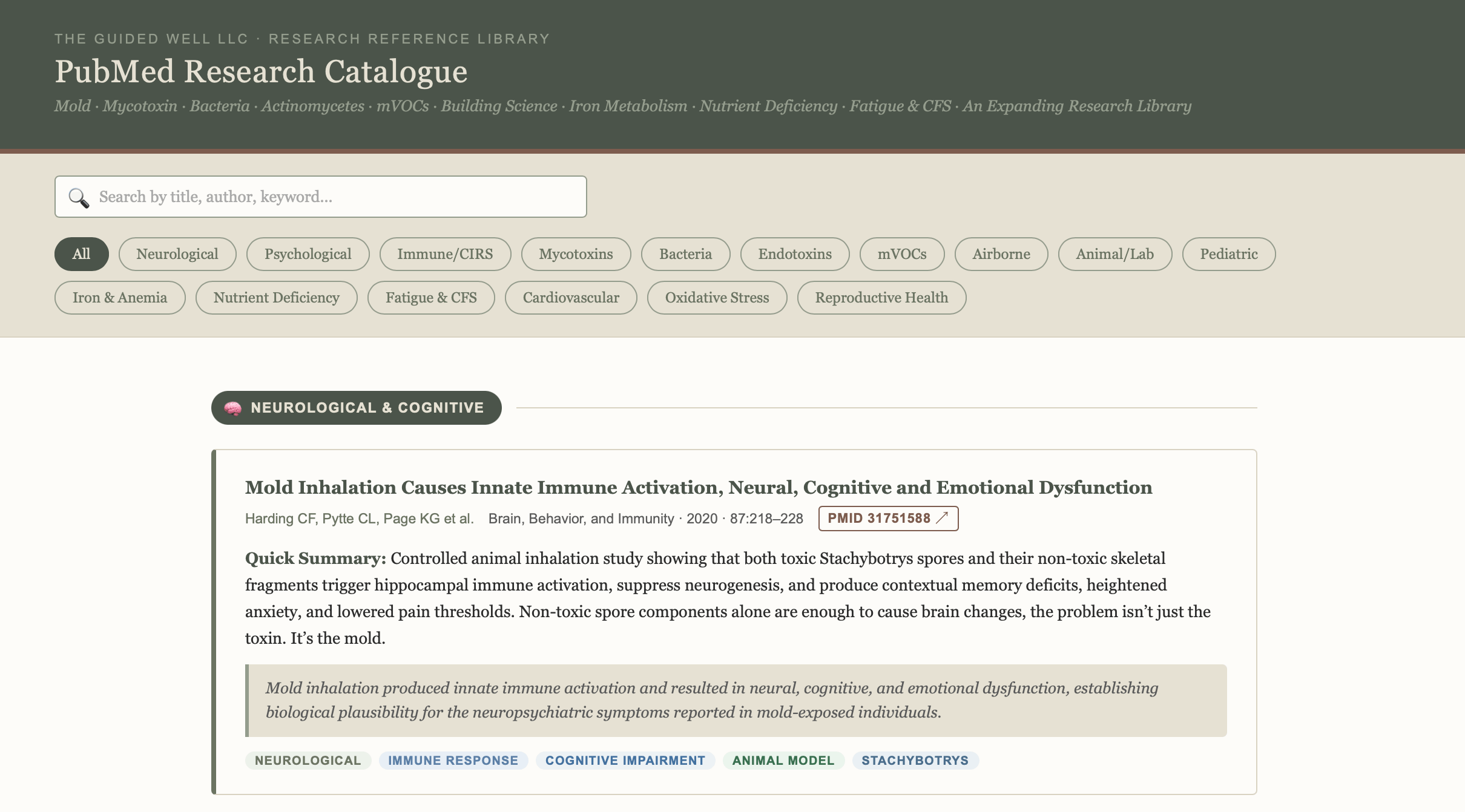
What I have built is a compilation of the papers I have found most valuable over the past several years, the ones I saved, returned to, shared with practitioners and sent to skeptical family members and used to advocate for myself in medical appointments.
It is organized by symptom category so you can search for what you are actually experiencing.
Every entry has a quick summary that tells you what the study found and why it matters, without requiring you to hold a graduate degree or a functioning prefrontal cortex to understand it.
This library houses the years of papers I have bookmarked, forgotten about then found again and have downloaded to my computer. It has taken time to organize it into something usable. And since I started this work, the body of literature has grown. More research has come out validating what many of us already knew in our bodies before we had the language to say it.
This is and remain a free resource.
You deserve to know what the research says.