
Scent Without Consent
The quiet rise of undisclosed chemical exposure in public spaces

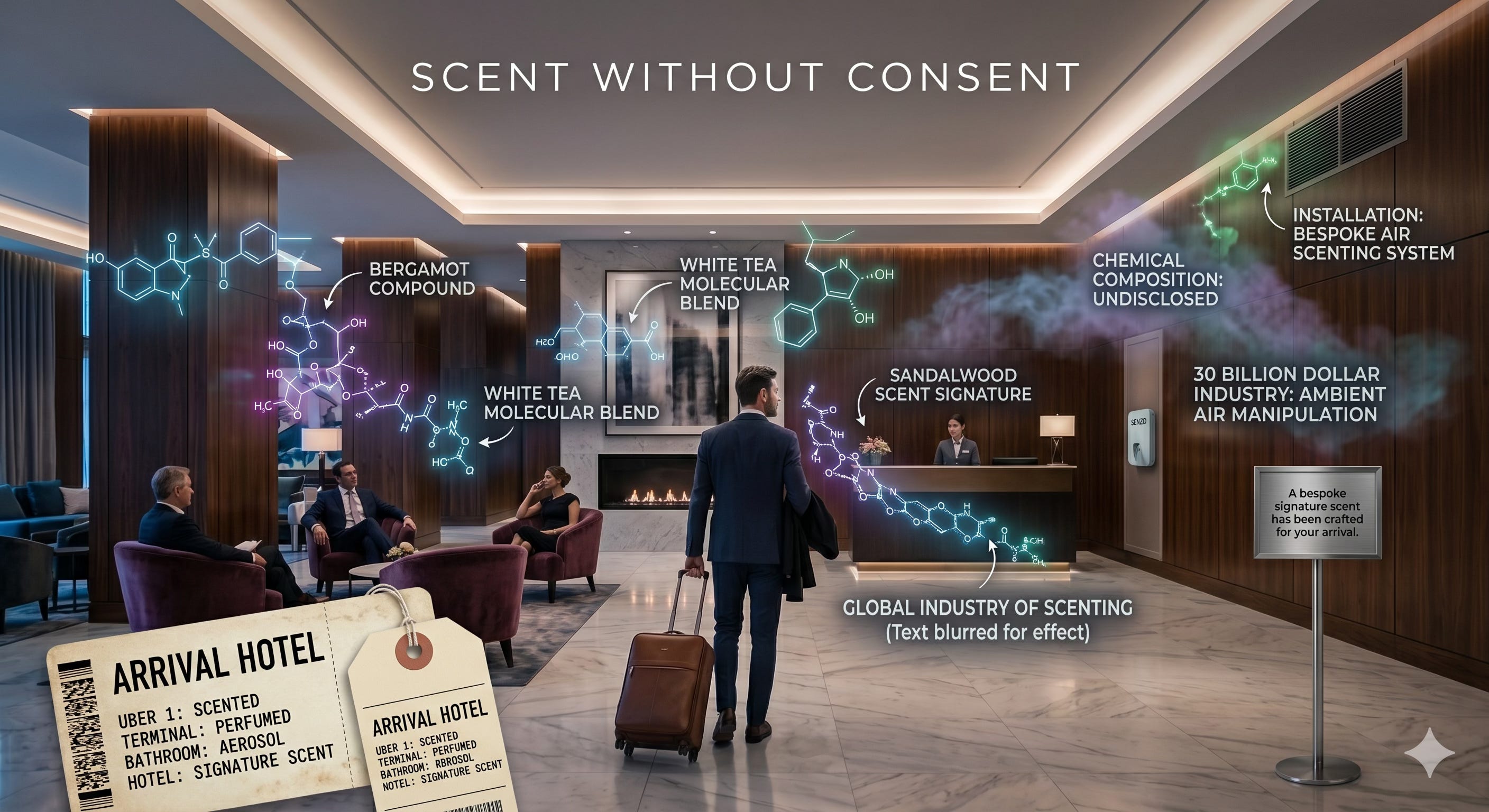
The Scent Vignette
You leave the house at 4:47 a.m. Your home is unscented, which took years to achieve and a long, expensive illness to understand was even a choice. You have slept in your own purified and unscented air. Your sheets smell like nothing. You pull the door shut and step out into the predawn driveway and for one glorious minute the world smells like itself — asphalt cooling, wet leaves, a neighbor’s chimney.
Then the Uber pulls up.
The smell hits you before even get in the car. Black Ice or Little Trees or one of those cardboard visor clips — you can’t see where it’s coming from, but you can taste it. Acrid, synthetic, layered on top of a fabric softener ghost and whatever the driver sprayed after the last passenger. Thirty seconds in and your throat is tightening. You can’t crack the window because it’s 34 degrees outside. You breathe shallowly and pray for a quick ride.
The drop off at JFK is an olfactory decompression of about four seconds — just long enough to register diesel, jet fuel and the vague chemical wash of a city curb in early spring — before the automatic doors open and you’re inside a climate controlled atrium being gently perfumed by a ventilation system you cannot see or avoid. The security line is elbow to elbow and unkind to a nose that works. The man behind you is wearing cologne that registers as aldehyde and white musk. The woman in front smells like Tide original and fabric softener in that particular laundered-three-times over way that means her clothes are actively off gassing into the air everyone else is breathing. Someone has sprayed Japanese Cherry Blossom spray into a hoodie. A toddler drifts past in a wake of Dreft, scented diapers and baby lotion. You are breathing in hundreds of strangers chemical signatures in a space the size of a garage.
Past security, the terminal opens up and the scent dilutes — but it does not disappear. Depending on which airport you are in, what you are smelling is not only the residue of everyone else. It has been installed. A growing number of terminals worldwide — Singapore Changi, Heathrow’s arrivals hall, San Luis Obispo, San Francisco International, Abu Dhabi — run bespoke signature scents through their ventilation systems or through standalone diffusers at key touchpoints. You know what it is because you have seen the machines tucked behind the signage in airports from Cabo to JFK.
Before you get on your flight you stop in the bathroom.
The SENZO unit is mounted at eye level. You can see the aerosolized scent plume. It pulses every few seconds into a 35 sq foot room being used by twenty women, a room that has one narrow return vent caked in dust and the oil residues that make the scent stick. You start tasting the aerosol on the back of your tongue. Again you are forced to breathe shallowly and maybe even hold your breath. You wash your hands with soap that SHOCKER is fragranced — the 3rd party dispensers the airports use now, never unscented, never labeled — and you leave faster than you came in.
At the gate, more scents. Boarding the plane, more perfume, jet fuel and unidentifiable chemical scents — of course, because a hundred and eighty strangers have all bathed themselves in laundry detergent, dryer sheets, deodorant, cologne, hairspray and hand lotion and now they are seated and sealed in a pressurized aluminum tube with you for five hours. The flight attendant leaning in to take your drink order is wearing something floral and heavy that she is wholly unaware of and can no longer smell herself. The 15 sq foot airplane bathroom has a little scented puck hooked over the sink that is supposedly neutralizing bodily odors but instead is just adding another scent layer. You drink water. You try not to think about it.
You land. You retrace the whole gauntlet backwards through arrivals. Customs. Baggage. Automatic doors. Outside, the warm air hits you and for a second you think… sweet relief. Until you register the idling buses, the jet fuel and the exhaust. Then you get in the next Uber. It is scented, of course.
The hotel lobby is the final act. You were hoping for a clean, neutral arrival. What you walk into is a fragrance a hospitality consulting firm developed for this brand at somewhere between forty and seventy thousand dollars a year per property. Bergamot and white tea, probably. Or fig and sandalwood. It is diffused through the lobby HVAC and it is heavy. You can feel it in your sinuses before you reach the check-in desk. The elevators smell like it. The hallway to your room smells like it. You open the door to your room and smell the cleaning chemicals from turnover with notes of the cheap air freshener used to mask the cleaning chemicals and underneath both, the fabric softener in the sheets.
You have been awake for fourteen hours. Since leaving home you have not inhaled a single cubic meter of air that did not contain some form of synthetic chemistry.
This is not an accident. It is not a trend. It is a 30 billion dollar global industry of ambient air manipulation that most people have never been told exists. It is engineered into casinos. Subway tunnels. Airport terminals. Hotel lobbies and hotel bathrooms. Retail stores. Office buildings. Gyms. Waiting rooms. The literal air of the public commons. And nobody is required to tell you what is in any of it or even that it’s there…
Let me walk through how we got here. But first, let’s start with what “fragrance” actually is.
What “fragrance” actually is
One word on an ingredient label. A dozen, a hundred, sometimes several hundred individual chemicals can all fall under this one word on a label.
100s of chemicals reduced to 1 word on a label —> “parfum” or “fragrance.”
Under the 1966 Fair Packaging and Labeling Act, fragrance formulas are protected as trade secrets. A company can list every other ingredient in a perfume, a lotion, a detergent, a dryer sheet, a soap, a diffuser oil, a candle — and then list “fragrance” or “parfum” as a single line item that legally stands in for the entire aromatic concoction. The FDA confirms this directly. They also note, plainly, that products labeled “unscented” can still contain fragrance — because companies use fragrance chemicals to mask the smell of other ingredients without producing a noticeable scent.
The dominant classes of chemicals hiding inside that one word are volatile organic compounds (VOCs), phthalates used as fixatives so scents last longer, parabens, synthetic musks, aldehydes and several hundred proprietary aroma molecules. The research on the cornucopia of synthetic chemicals we call fragrance is clear. A 2025 review in Frontiers in Toxicology and a 2023 review in the journal Toxics both land in the same place: perfumes, air fresheners, laundry products and personal care products are significant contributors to indoor air pollution, and repeated exposure is linked to allergies, respiratory problems, endocrine disruption, reproductive issues and cancer risk. Phthalates in particular are endocrine disruptors — they mimic hormones and interfere with normal hormonal signaling. Fetuses and young children are the most vulnerable, and avoidance is close to impossible because exposure is now everywhere.
The body has three entry points for these chemicals. Inhalation, which is how you get them from the Uber and the bathroom diffuser. Ingestion, which is how you get them from the aerosol you can taste on the back of your tongue. And dermal absorption through the skin — your largest organ, a reliable delivery vehicle for fat soluble compounds into systemic circulation. Everyone you know who wears perfume or scented lotion is treating their body as a daily dosing system for a cocktail of chemicals they cannot name and have not consented to.
Have you gone nose blind?
Before we go any further, I need to explain the mechanism, because almost every argument against what I am about to describe collapses if you understand the science of how the human olfactory system actually handles chronic fragrance exposure. This is the part most wellness content skips over, and it is the single most important piece of the story.
Have you ever noticed that once you go scent free and then are re-exposed to scent it feels almost like a literal slap to the face when you encounter it again? Or have you noticed that your friend who uses Tide pods, Gain dryer sheets and perfume literally cannot differentiate the smells and does not smell or perceive how strong they are? Well, there is a reason.
When you walk into a scented room, your olfactory receptor neurons — the specialized cells lining the roof of your nasal cavity — detect the airborne chemicals and send a signal to your brain within milliseconds. That is the part you already know. What happens next is the part the fragrance industry knows and most consumers do not.
Within seconds of continuous exposure, those same receptor neurons begin to downregulate. The G-protein coupled receptors on the cilia of the olfactory sensory neurons physically reduce their responsiveness to the odor that just hit them. This is an active, energy consuming process — not fatigue, not failure, but a deliberate biological dampening. Calcium floods into the cell, calmodulin dependent protein kinases get activated, the cyclic AMP signaling pathway gets shut down, and the receptor itself can be internalized — pulled off the cell surface entirely. After a few minutes of continuous exposure, you can no longer detect the odor at the same intensity. After an hour, you may not detect it at all.
This is called olfactory habituation, or more colloquially, nose blindness. And while it was once assumed to be purely a peripheral phenomenon — something happening only at the receptor level — functional MRI studies over the last twenty years have shown it is also a central nervous system process. The piriform cortex, the entorhinal cortex and the amygdala all dampen their responses to repeated odor exposure. Your brain, quite literally, learns to predict the constant stimulus and then suppresses your conscious perception of it in order to free up cognitive bandwidth for new information.
Everything I have just described is a protective adaptation. In a natural environment, it is profoundly useful. Our ancestors needed to be able to smell the new smell — the approaching predator, the spoiled food, the distant smoke — not the ambient baseline of whatever they were already standing in. Habituation is what allows detection of change. It is a survival mechanism.
Now take that survival mechanism and put it inside a 21st century built environment that has been deliberately, commercially and continuously flooded with synthetic fragrance chemicals engineered to persist. This is where the story turns.
Modern fragrance molecules — especially the class of synthetic fixatives called polycyclic musks, with galaxolide and tonalide being the two most widely produced — are not designed to evaporate quickly. They are designed to stick. That is their entire job. They are lipophilic, which means they are fat soluble and water resisting. They bind to skin lipids, to hair, to fabric and to the mucous membranes lining your nose and airways. They persist on those surfaces long after you have stopped consciously smelling them. They are also slow to biodegrade, which is why global environmental chemistry studies have found them in wastewater, rivers, fish, household dust and indoor air samples across multiple continents.
They also bioaccumulate in human tissue. Galaxolide and tonalide have been detected at measurable concentrations in human fat, human blood, breast milk, placenta and umbilical cord blood. One study in China found the compounds present in breast milk samples across every province tested, with concentrations correlating directly to the mother’s use of fragranced personal care products. Toddlers have higher daily exposure levels than adults, likely because of their smaller body mass, higher ventilation rate per kilogram, and the density of fragranced products in their immediate environment — detergents, soaps, lotions, diaper products.
Pull these two pieces together and the shape of the problem emerges. You are being chronically exposed to fragrance chemicals that are engineered to persist, that bind to your mucous membranes and accumulate in your fat cells — and your olfactory system is actively, biologically, adaptively making it harder for you to perceive the exposure. You stop smelling the molecules. The molecules do not stop being there. They are still on your skin. Still in your clothes. Still in your hair. Still in the fat cells of every woman of reproductive age who has used scented personal care products for a decade.
As an aside this happens in moldy/musty buildings as well and usually is recognized if the occupant leaves for an extended vacation then comes back to their environment.
Here is the part that will matter most to anyone reading this who has ever been called dramatic over the assault of fragrance. Multiple fMRI studies have shown that people with multiple chemical sensitivity and severe fragrance intolerance process odors differently at the cortical level. They do not habituate the way others do. Their piriform cortex continues responding. Their perceived intensity of the odor does not decline over time. Their brains, for reasons that are still being investigated, do not execute the protective suppression that the rest of the population runs by default.
This is not evidence that chemically sensitive people are broken. It is evidence that they are reporting accurately. They are perceiving what is objectively present. The so called canaries (myself included) never get that nose blind reprieve. The rest of the population has stopped perceiving it because their neurobiology has been successfully co-opted by an industry that depends on exactly that suppression.
Once you understand this, several things get clarified at once. Why people in heavily scented homes cannot smell their own homes. Why the perfume wearer in the elevator with you has no idea what she is doing to the air. Why flight attendants spray on fragrance that their spouses, eighteen hours later, will still be able to smell on them. Why a commuter walking through the Grand Central shuttle passage can report “smells like Christmas, kind of nice” while a woman with a diagnosed disability has her throat closing. Why most passengers move through Singapore Changi with no conscious awareness that a bespoke signature fragrance has been dispersed around them at measured intervals throughout their entire transit.
And — most critically for the argument of this piece — why the harm is invisible and inescapable. The ambient scent industry is not successful despite the fact that most people cannot consciously perceive what is being deployed. It is successful because of it.
A reasonable response to everything I have just described is to assume there must be a paper trail somewhere that closes the gap. If the human olfactory system has been biologically outpaced by modern fragrance chemistry, surely the regulatory system has not. Surely a person inhaling an engineered chemical mixture in a public space has a legal right to know what is in it and to be notified of the exposure — an ingredient label, a disclosure document, a sign on a wall or PA message, a filing with the FDA or OSHA, something.
There are, in fact, three such disclosure frameworks in United States law. Each one is designed to tell the public what it is being exposed to. And fragrance, as a regulatory category, has been engineered to pass through all three of them untouched.
The Disclosure Stack
Three layers of law exist to tell the public what it is being exposed to. Fragrance passes through all three untouched.
Layer one is the product label. The fragrance loophole handles that one. One word can encompass hundreds of chemicals. No further disclosure is needed due to trade secret protection. A company can list “fragrance” as an ingredient that is an umbrella for a 100 chemicals and the consumer is none the wiser.
Layer two is the Safety Data Sheet — the expansive disclosure document governed by OSHA’s Hazard Communication Standard. Every hazardous chemical used in a workplace is supposed to have one. Section three of the SDS is titled “Composition/Information of Ingredients.” That section, by federal regulation, allows trade secret claims — meaning even the industrial exposure version of the disclosure document can leave the fragrance components blacked out. And the SDS obligation only attaches to workplaces. OSHA explicitly exempts consumer products used “in the same manner that a consumer would use them” — meaning Bath & Body Works pumping twenty to thirty pounds of Fresh Balsam through a sealed subway tunnel for a month can be classed as consumer use and can therefore bypass the SDS obligation entirely. Nobody is home dispersing thirty pounds of fragrance through their HVAC. That is industrial scale diffusion. But the regulation was not written to catch it.
I tested the third layer myself. I wrote to Bath & Body Works asking for a Safety Data Sheet on their fragrance — any fragrance. I never received so much as an acknowledgment of receipt. There is no SDS for the Fresh Balsam pumped into 42nd Street. There is no document in existence that I, as a person unwillingly inhaling it, have legal standing to request. I am not their employee. I am not their purchaser. I am the downstream recipient of an industrial scale aerosol whose disclosure obligations have been legally optimized to zero. (See below for the back story)
Layer three is whatever protection you have as a member of the public, breathing fragrance in a space you cannot leave. That layer does not exist and your body is the one keeping score.
Casinos Figured This Out 34 Years Ago
The ambient scent industry did not start in airports or on the 42nd Street shuttle. It started on the gaming floor.
In October 1991, a neurologist named Alan Hirsch ran a controlled experiment at the Las Vegas Hilton. He odorized two slot machine areas with different scents and left a third area unscented as a control. Over a single weekend, the amount of money gambled in the slot machines surrounded by one of the scents was 45.11% higher than the amount gambled in the same machines the weekends before and after. The effect was larger on Saturday, when he raised the concentration of the odorant — 53.42% higher. The other scent did nothing. The control area did nothing. The effect was one specific scent, at a higher concentration, interacting with a specific population of bodies. His study was peer-reviewed and published in Psychology & Marketing in 1995, and it is still cited by the scent marketing industry as foundational.
Gamblers, in a confined space, spending 45% more money because of an aerosol they could not identify and did not consent to. That is the origin document. The original proof of concept. Scent can affect behavior (and evoke emotion and memory.)
Every Wynn, every Bellagio, every Aria, every Mirage — and now every Westin (White Tea), every Ritz-Carlton, every Hyatt Place (Seamless) — is running a descendant of that 1991 experiment on its guests. The global commercial scent machine market was $1.5 billion in 2023 and is projected to reach $3.7 billion by 2032, growing at roughly 10% per year. Hotel scent marketing alone is on track to be its own billion-dollar category.
These are not decorative details. They are intentional, engineered, behavioral infrastructure.
What You Are Actually Breathing At The Airport
I want to pause here because I hear the same reaction from people every time I bring this up: “Come on, airports aren’t actually pumping fragrance through the HVAC.”
So let me show you the receipts.
Singapore Changi has a bespoke signature fragrance called Changi Scent, developed in a multi-year engagement with scent marketing agency AllSense and Oo La Lab. It has notes of orchid, Damask rose, Asian spices and essential oils marketed by the airport as able to “calm nerves and lower blood pressure.” Per the airport’s own statements, it is dispensed at departure hall doors and other key areas throughout the sprawling terminals. You can buy the candle and reed diffuser version at the Jewel mall gift shop for $14 to $18.
Heathrow’s arrivals terminal is scented by Charlotte-based ScentAir, per reporting by The Points Guy. ScentAir also provides the diffused fragrance programs for United Airlines lounges and a range of other aviation clients it is contractually barred from naming due to nondisclosure agreements. That phrase — “contractually barred from naming” — is itself the story. When the public health disclosure of an aerosol exposure is governed by a commercial NDA, the public is not the client. The airline is.
San Luis Obispo County Regional Airport added ambient fragrance to its ticketing and baggage claim areas when it opened a new terminal, a decision the airport’s director stated on the record to CNBC was “borrowed from the hotel industry.” Tampa International Airport told CNBC it had narrowed its forthcoming terminal fragrance down to three options “reflecting the Tampa Bay Region — ocean, wood, tropics, greenery.” Abu Dhabi International, Air France’s La Première terminal at Charles de Gaulle, Istanbul’s UMA luxury terminal and various Delta, United, Alaska Airlines, All Nippon, Cathay Pacific and Singapore Airlines lounges around the world run bespoke signature fragrance programs through commercial diffusion systems — some standalone, some integrated directly into HVAC infrastructure.
The entire commercial scent machine industry — companies like Air Aroma, Aroma360, ScentAir, Air-Scent, Hotel Collection, Mood Media, Rochester Midland, Maison 21G — markets HVAC integrated diffusion explicitly to airports as a standard product offering, with coverage specs up to 210,000 cubic feet per unit. This is now a campaign and product category.
When I wrote that the terminal scent has been installed, I meant it. The reason most travelers do not notice it is the reason we covered above. You have stopped perceiving it. And that is part of the design.
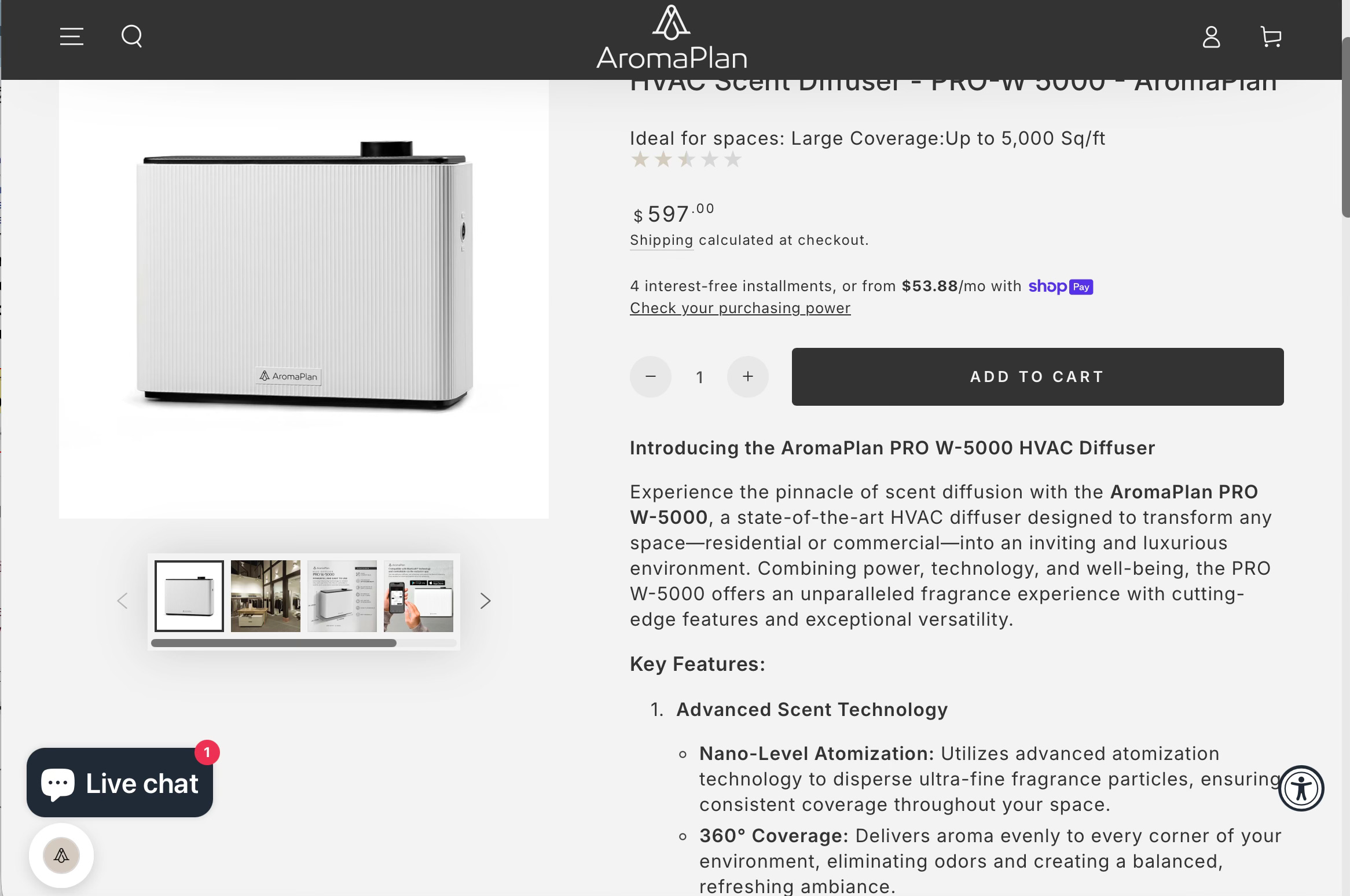
The Start of Scented Ad Campaigns
There was something that happened close to me this past holiday season that had me do a deep dive on this topic. I think a lot of people missed what actually happened.
For most of the last thirty years, ambient scent deployment operated with a kind of plausible deniability. Hotel signature scents were described to the public, when they were described at all, as “hospitality” — atmospheric touches meant to enhance an experience. Airport diffusion systems were framed as part of “passenger experience design.” Retail scent marketing was sold internally as “ambiance.” The word nobody in the industry used, in public, was manipulation. The word nobody in the industry acknowledged, in public, was that the exposed party — the traveler, the shopper, the guest — had not consented, had not been told and had no way to opt out.
That changed in November 2025.
The Metropolitan Transportation Authority (MTA) of New York — the public entity responsible for moving roughly four million people a day through the New York City subway system — signed a paid advertising partnership with Bath & Body Works. Under this partnership, for the full month of November, Bath & Body Works diffused its Fresh Balsam holiday fragrance into the 42nd Street shuttle tunnel that connects Grand Central Terminal to Times Square. The campaign was branded “Grand Scentral Station.” Diffusers were mounted on the steel girders above the shuttle platform and along the walls of the connecting tunnel. Bath & Body Works estimated it would disperse twenty to thirty pounds of fragrance over the course of the month. Read The Announcement Here
Three things made this event different from everything that came before.
First, it was not hospitality. It was not passenger experience design. It was not ambiance. It was an advertisement. The MTA itself called it their first ever “aroma ad,” and went out of its way to tell journalists they were seeking new revenue streams. For the first time, a public transit authority had explicitly reclassified a tunnel full of commuters as a captive audience for olfactory commercial advertising.
Second, the commuters in question were captive in a way that mall shoppers and hotel guests are not. The 42nd Street shuttle is not a destination. It is an infrastructure choke point. Millions of people have to cross it to get between the two busiest transit hubs in North America. Asthmatics cross it. Pregnant women cross it. Children cross it. People with chemical sensitivities, mast cell activation, autoimmune conditions and those undergoing current cancer treatment cross it. For a full month, none of them had a non fragranced alternative route.
Let’s take a second to notice a cultural inconsistency. Schools across the United States routinely ban peanut butter from cafeterias and classrooms to protect students with peanut allergies. Roughly two percent of children in the US carry that particular allergy. Two percent has been deemed a sufficient share of the affected population to warrant packaging disclosure, cafeteria policy, airline accommodations and a cultural vocabulary of “nut free.” Meanwhile, the most rigorous peer reviewed population study on fragrance sensitivity in the US — Dr. Anne Steinemann’s 2016 paper in Air Quality, Atmosphere and Health — found that 34.7% of American adults report adverse health effects from fragranced products. Breathing difficulties. Migraine. Asthma attacks. Dizziness. Rashes. Seizures. For approximately one in ten of those adults, the reaction is severe enough to meet the definition of disability under the Americans with Disabilities Act. Fifteen percent reported losing workdays or losing a job due to a fragrance exposure at work in the previous year. We are talking about an allergen class that affects, at minimum, seventeen times more Americans than peanut allergy. And what does the built environment do about it? We ban peanut butter from a cafeteria used by a few hundred students. We pipe the larger known allergen through a subway tunnel used by four million people a day.
Both are allergens. Only one gets treated like one.
Third, and this is the part the news coverage largely missed, the exposure was visible. Not metaphorically visible. Actually visible. The diffusers were mounted overhead and puffed vapor in short bursts on a repeating cycle. If you looked up, you could see the plume coming down. This was not a subtle background note engineered into HVAC infrastructure. This was overt, industrial scale aerosol deployment in a sealed public transit environment. The industry, for the first time, dropped the plausible deniability and did it in broad daylight.
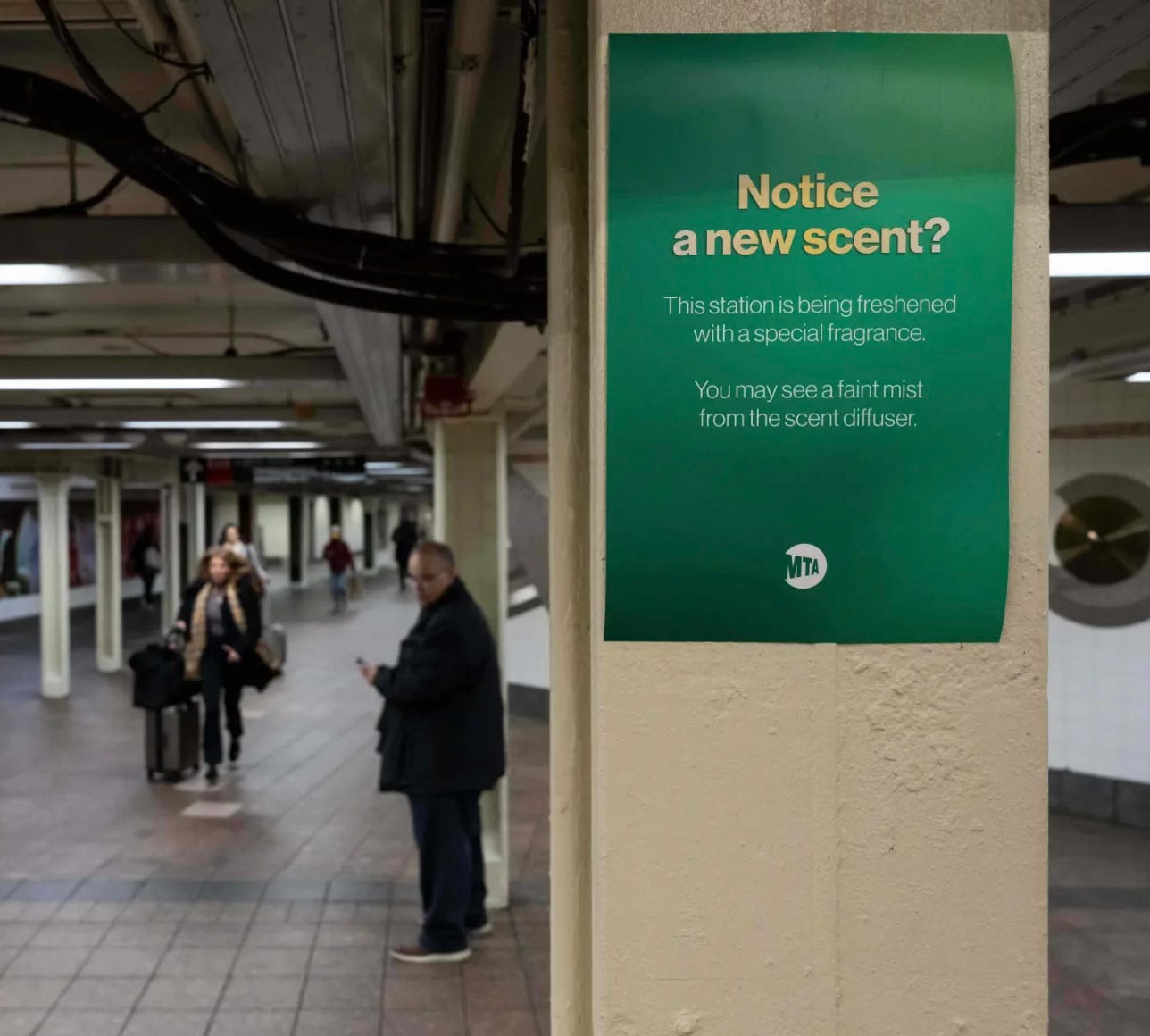
There is a fourth thing worth naming. For the first time in 30+ years of ambient scent deployment, the public was told it was happening. MTA placards went up on the platform columns. The signs read: “Notice a new scent? This station is being freshened with a special fragrance. You may see a faint mist from the scent diffuser.” It is tempting to read those signs as disclosure. They are not. They are two other things, both commercial. The first is ad coordination: the entire commercial logic of the campaign was that commuters would identify the Fresh Balsam fragrance, associate it with Bath & Body Works and walk out of the tunnel and into a store. The ad does not convert if the consumer does not know what she is smelling and knows where she can buy it. The sign was therefore not a safety notice. It was a retail cue. The second is panic preemption: a visible aerosol plume, in short bursts, from ceiling mounted devices in a major metropolitan subway system, activates a category of cultural memory that any transit authority has to manage. The 1995 Tokyo sarin attack on the Tokyo subway, nearly every Hollywood chemical attack sequence ever filmed and a post-9/11 commuter public are what a transit authority is managing with those signs. The signs are the bomb squad insurance policy for a corporate fragrance deal. They are not the ingredient list. They do not tell you what you are breathing. They do not give you an opt-out. They do not point to an SDS or an accommodation policy or a complaint line. They tell you three things the MTA needed you to know in order to protect a revenue partnership and head off a different kind of public safety panic. The actual disclosure obligation — the ingredients, the volume, the duration, the liability — was left exactly where the rest of the ambient scent industry has always left it. Nowhere.
The public reaction split predictably. Most of the TikTok coverage was enthusiastic — commuters who liked pine, commuters who preferred “Christmas” to “old subway,” commuters who had no idea what any of this had to do with them. But a second group of reactions was different, and this is where the story actually lives.
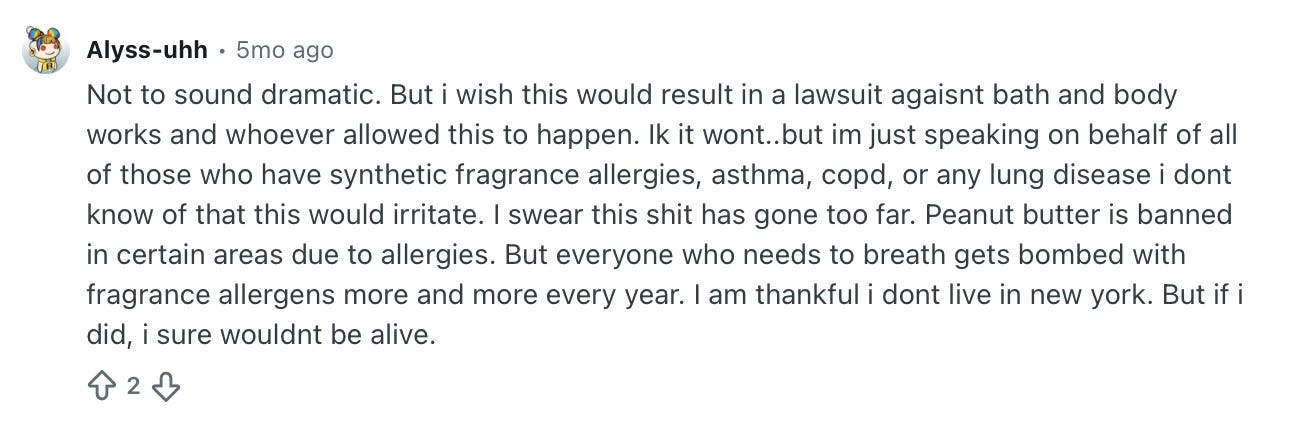
A twenty-five-year-old law student named Cami Oresky walked through the tunnel on her way to class. She has a diagnosed fragrance allergy and multiple chemical sensitivities, conditions recognized as disabilities under the Americans with Disabilities Act. Her eyes started swelling. Her throat started tightening. She had what she described as an immediate physical reaction. She could not use her normal route. She started a petition arguing that the installation was creating an invisible disability barrier in a public transit system that is legally required to be accessible to everyone.
The MTA told reporters they had received no complaints. (Just go to B&Bs Instagram and look for the posts promoting this and you can see that’s patently false.)
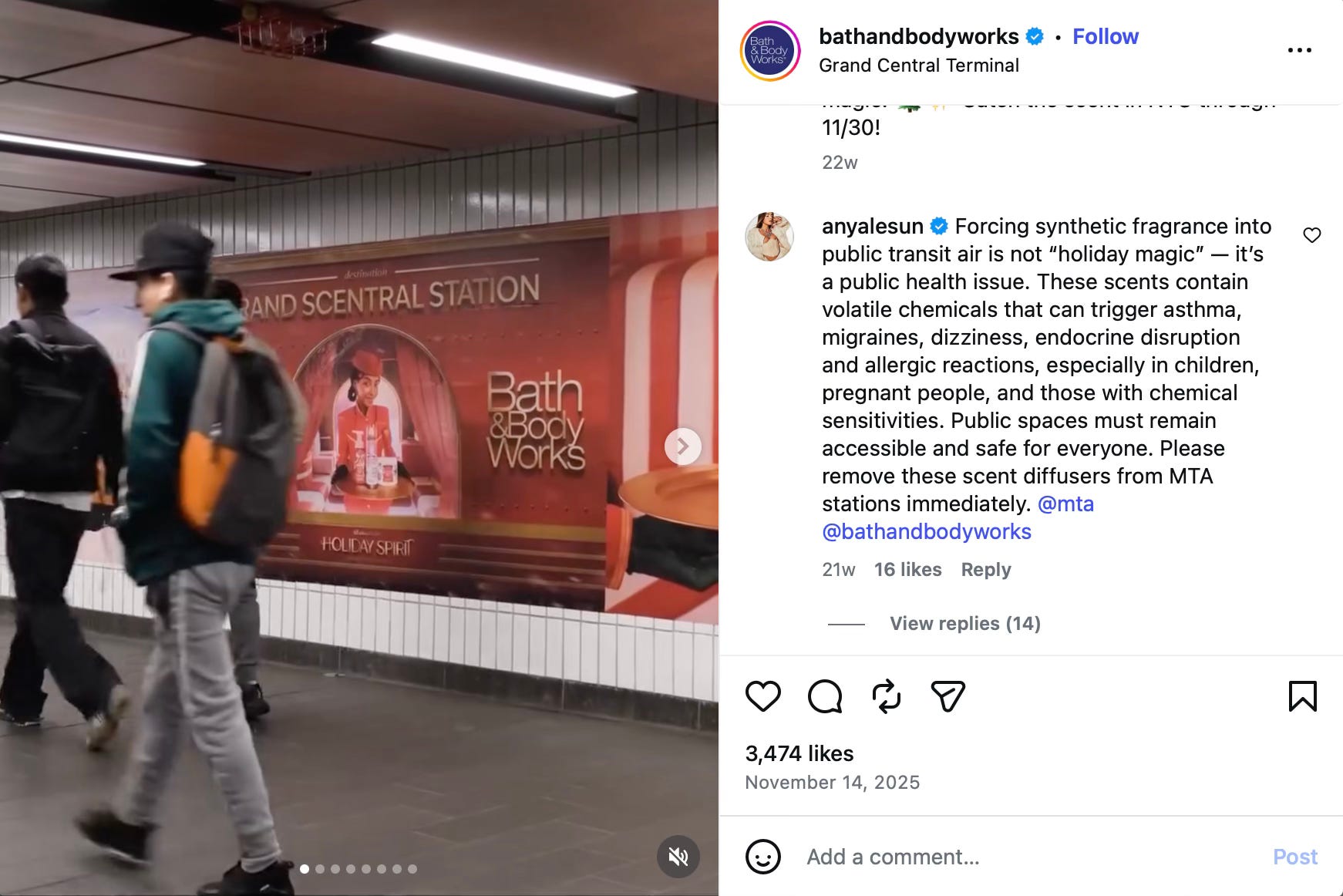
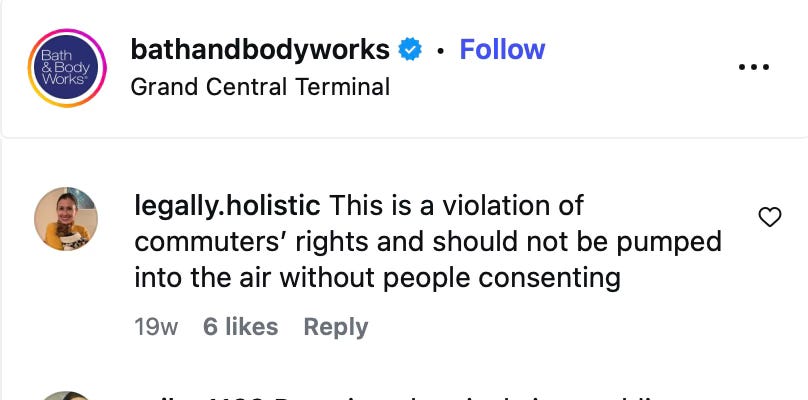
But this is where the actual question of this piece comes into focus. Not whether some commuters enjoyed the smell — plenty did. Not whether fragrance is, in some abstract sense, pleasant. The question is whether it is legal to expose people and more importantly whether it is ethical, to aerosolize a proprietary undisclosed chemical mixture onto a captive population moving through public infrastructure, with no mechanism for that population to consent to the exposure, opt out of it, or even find out what is in it.
Because the harm here is not limited to the people whose throats close. The harm includes every person who now has to choose between two bad options: inhale something they did not agree to inhale, or stop using a public space they otherwise need and want to use. For the month of November, a stretch of New York City public transit infrastructure became inaccessible to anyone with a diagnosed chemical sensitivity, asthma, ongoing cancer treatment, pregnancy complications, or migraine disorders — along with the much larger silent category of people who simply did not want to be chemically dosed on their commute and had no platform for refusing. The ad campaign did not just add a smell to the shuttle. It removed the shuttle as an option for a meaningful slice of the population who wanted and needed to use it.
That is the pattern this piece is tracking. It is not about whether fragrance is good or bad. It is about the quiet, undisclosed transfer of health risk from the corporations deploying these chemicals to the public breathing them and the systematic erosion of one’s ability to choose which chemical environments to enter...
And the question Cami Oresky’s petition is now testing — whether piping a paid corporate fragrance through a sealed public transit tunnel for a month constitutes a violation of federal disability law — is the first real legal challenge to the ambient scent industry in the United States.
Which brings us to the legal question most of you are probably asking by now. How is this even allowed?
The legal vacuum
In employment, there is real precedent. In McBride v. City of Detroit, a senior city planner with multiple chemical sensitivity was awarded $100,000 after the city refused to accommodate her reactions to a coworker’s perfume and a plug in room deodorizer. The federal court ruled that her MCS was a disability under the ADA because it substantially interfered with the major life activity of breathing. The city subsequently adopted a fragrance free policy. Similar accommodations exist in workplace settings for asthma, severe allergies and other respiratory impairments.
In public accommodations — airports, transit, retail, hotels — the ground is much softer. The ADA technically covers public accommodations under Title III, but no federal court has cleanly ruled that piping fragrance into a tunnel, a lobby or a terminal violates accessibility law. It has not been tested. The Oresky petition is, in effect, an early attempt to test it.
So the honest answer to the question of whether we consent to ambient fragrance exposure by entering a public space is that the question is legally unsettled. The disability rights framework clearly applies in principle. The enforcement infrastructure has not caught up to ambient aerosol marketing in practice.
And outside of ADA, what other personal protection do we have against exposures with known health implications that we wouldn’t consent to if given a choice and asked?
(I am not a lawyer and this is not legal advice. This is where the case law actually stands as of this writing.)
What repeated exposure does to a body
The mechanism we covered earlier explains why most people cannot perceive what they are being exposed to. It does not yet explain the opposite phenomenon — what happens to the minority of bodies that stop cooperating with the suppression.
Fragrance sensitization runs the other direction from habituation. Once the body has developed a reaction to a class of chemicals, re-exposure triggers it at progressively lower doses. This is well documented in both the allergy literature and occupational medicine. It is why I, who used to burn candles and mist Febreze without a second thought, cannot tolerate walking within 50 ft of a fragrance store. My body did not get weaker. My body got informed. This should sound very familiar to the mold and CIRS community.
The unsettling experience most people will never have is the reverse one. Remove scent from your environment for long enough — 3 months to a year — and then walk back into the perfumed world and you will discover that the world is not mildly aromatic. It is suffocating. It is oppressive.
The average American home, airport, hotel, gym, retail store, Uber and office is operating at a volume that would have been considered assaultive forty years ago. And almost no one can perceive it because the majority of the population is living inside it.
What YOU Can Do
There is no clean escape, especially when you’re traveling and on vacation only exposure reduction and dilution. As the great Walter Crinnion said “the solution to pollution is dilution.” Diluting heavily scented air with fresh air when possible if always your best bet.
At home. Remove the sources you control. Truly unscented laundry detergent. No dryer sheets. No fabric softeners. No plug-ins, scent warmers, reed diffusers, candles. No scented personal care products — shampoo, conditioner, lotion, soap, deodorant. Read labels with the assumption that “unscented” may still contain masking fragrance and prefer “fragrance-free.” Baking soda, vinegar and castile soap cover most cleaning needs. Air filtration. Hypochlorus acid is also an underutilized tool.
When you travel. Bring your own pillowcase and sheet set if you are sensitive. Unplug every diffuser in the hotel room the moment you walk in and open a window or slider if they open. Ask housekeeping to skip turn-down service and any amenity sprays. Politely request Uber drivers not run the air freshener for your ride — most will agree. A well-fitted N95 is unglamorous but effective in the high-exposure choke points: airport security, jet bridges, hotel lobbies, ride shares.
When you shop. Assume “unscented” may be masked. Prefer “fragrance-free.” Read full ingredient lists. Search product reviews and consult apps like Switch Natural etc.
When you have the energy. Push back. Sign petitions like Oresky’s. Complain to the MTA, to your airport authority, to hotels whose signature scents are triggering you. Write to brands asking for SDS sheets. They will usually ignore you, the way Bath & Body Works ignored me. Send the letter anyway. The MOCRA expansion that would have required fragrance allergen disclosure at the federal level has been stalled by industry pushback and agency underfunding. States like California and Oregon are moving faster than the federal government, and public pressure is part of what decides how far those state laws ultimately go.
The deeper point
This conversation has to be explained from the ground up because we have all been taught, carefully, that smelling good is clean — and that the chemical signature of clean is a laundry aisle. We have been taught that luxury smells like a 5 star hotel lobby. We have been taught that a scented home is a cared for home. None of that is true. It is the most successful product category marketing scheme g in modern consumer history, and it has been so effective that a law student having a physical reaction to pine scented propaganda on her way to class can be described by the MTA as producing “no complaints.”
Your body is not overreacting. It is speaking. It has been speaking the whole time. The question is only whether you, and eventually the rest of the culture, will start listening.
The fragrance industry has engineered its way around every disclosure mechanism that currently exists. There is exactly one disclosure document they have not yet figured out how to redact.
That document is you.
If you have a fragrance exposure story — an Uber, an airport, a hotel lobby, a public bathroom, a tunnel — I want to hear it. Drop it in the comments!
Megan | The Guided Well
Where Your Home Meets Your Health
Agreed great article indeed, I relate on all fronts. It’s incredibly alarming how we’re all truly surrounded and engulfed in these ‘scents’
Great article! I wish there was greater attention to scents being everywhere. My bestie and I stayed in.a beautiful VRBO in the mountains but EVERYTHING was fragranced. The towels, the sheets and the plugins. I think this frangrance issue should be required information as an allergy risk and some way to opt out.